





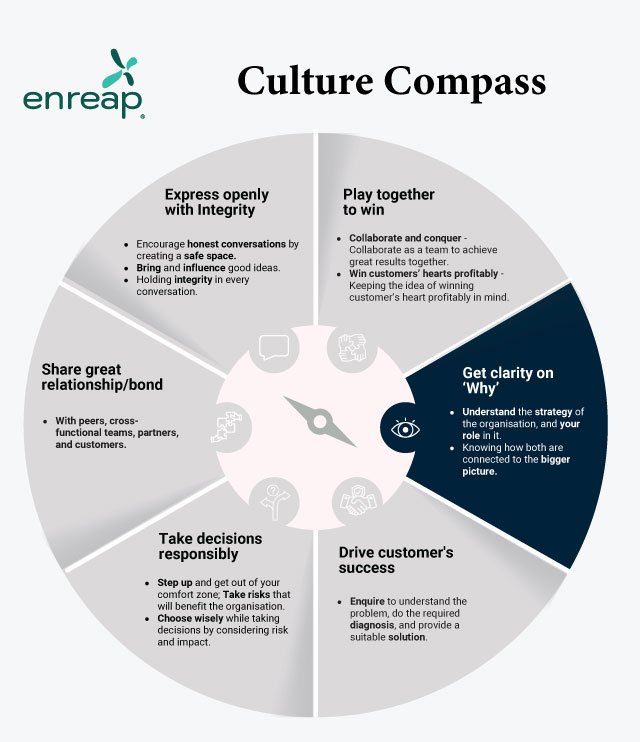
As part of its ongoing Culture Compass series, we are sharing the six ways of working that guide how teams collaborate, make decisions, and deliver value every day. These are not aspirational ideals but practical behaviours that shape how work gets done across the organisation.
This blog focuses on one of those practices: Get clarity on ‘Why’.
What does ‘Get clarity on why’ really mean?
At its core, getting clarity on ‘why’ is about understanding the organisation’s strategy and how individual roles connect to it. It begins with a simple but powerful question:
“Why am I doing what I am doing?”
When people understand how their roles, responsibilities, and even routine tasks contribute to the organisation’s broader goals, work becomes more cohesive. Instead of feeling fragmented, efforts align with the larger mission and vision of the organisation. The value created internally then translates into meaningful outcomes for customers.
This clarity shifts work from being task-oriented to purpose-driven.
The idea behind this way of working
When people understand why something needs to be done, they tend to make better decisions. They prioritise more effectively, ask relevant questions, and take ownership of outcomes rather than simply completing assigned tasks.
Clarity of purpose helps reduce misalignment, rework, and frustration. It also builds confidence. People know when to move forward independently, when to pause, and when additional context is needed.
“Earlier, I would just complete what was assigned. Now, I make sure I understand the reason behind it; it helps me deliver better, not just faster.” — Pankaj Kumar, Delivery
How we practise ‘why’ at enreap
At enreap, teams are encouraged to understand both the organisation’s strategy and their role within it. This enables individuals to see how their efforts contribute to the bigger picture and to customer value.
In practice, getting clarity on ‘why’ shows up through everyday actions such as:
- Asking questions to understand intent, not to challenge authority
- Connecting KRAs and KPIs to meaningful business and customer outcomes
- Understanding how individual tasks impact delivery and value creation
- Staying open to new perspectives and ideas
This approach creates alignment without the need for constant oversight.
“Once I understood how my role connected to customer outcomes, I started thinking beyond my own deliverables.” — Ketki, Technical Manager AWS
Why this matters to our people
Clarity brings confidence. When people understand the purpose behind their work, they feel more engaged and empowered to contribute meaningfully.
It also builds trust; teams communicate better, collaborate more effectively, and make decisions with greater ownership.
“Knowing the ‘why’ helped me adapt to change more easily. It didn’t feel imposed, it felt explained.” — Saurabh, Human Resources
A shared responsibility
Getting clarity on ‘why’ is not limited to leaders or managers. While leaders are expected to provide context, every team member is encouraged to ask questions, connect the dots, and understand the impact of their work.
When both sides take responsibility, clarity becomes part of how we work, not an exception.
Working with purpose
Getting clarity on ‘why’ encourages people to slow down just enough to make better decisions. It gives direction to effort and meaning to work. When individuals understand how their roles connect to enreap’s strategy, they do more than complete tasks—they contribute with intention.
This way of working reinforces that purpose is not abstract. It is visible in the questions people ask, the context they seek, and the ownership they take every day.
As the Culture Compass series continues, the next chapter explores what happens once clarity is in place—how strong relationships are built and shared, and how collaboration becomes more human, meaningful, and sustainable. Because understanding why work is done matters, but how people work together is what truly drives progress.