



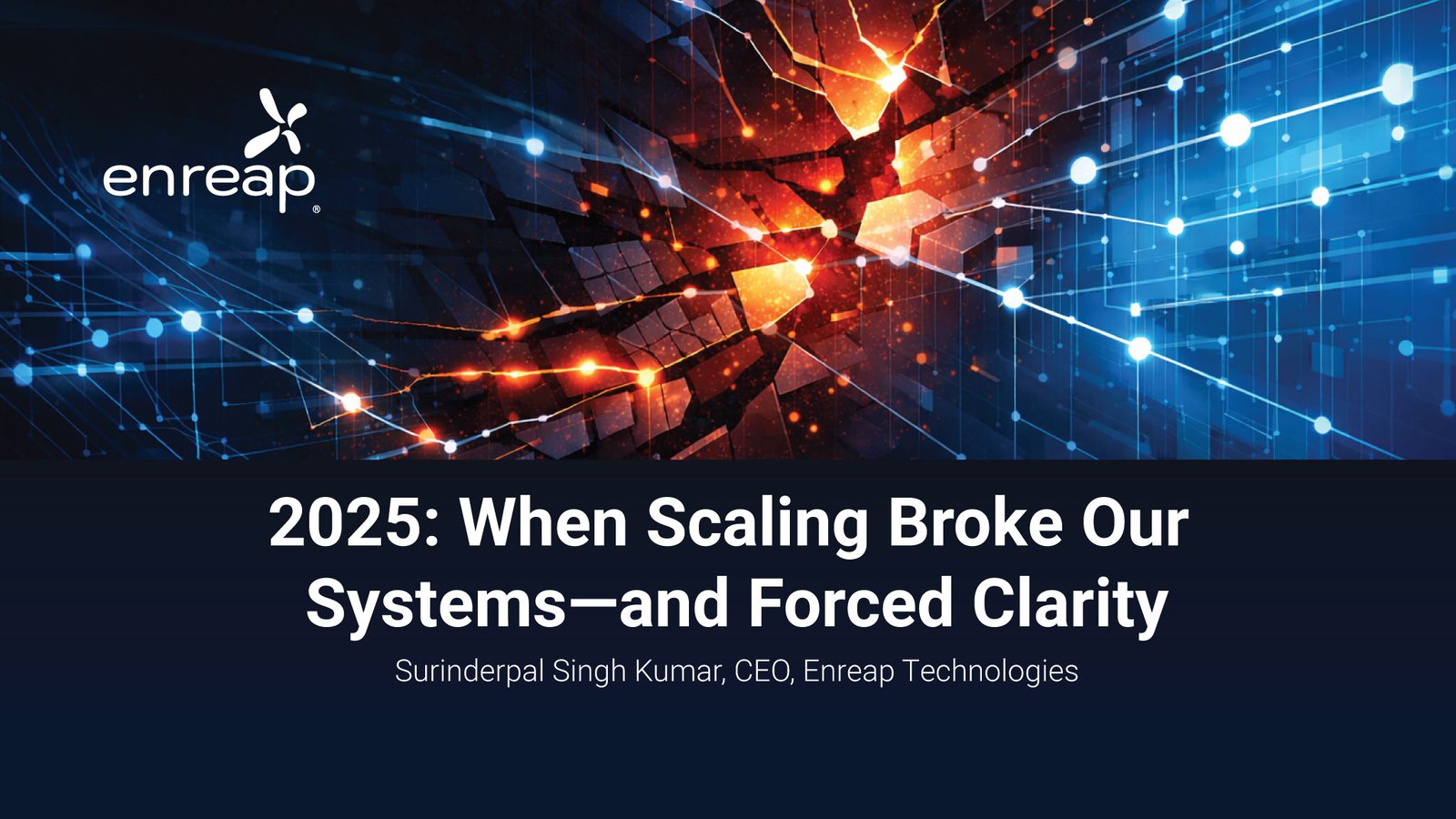
Twelve years ago, enreap started with one product, one market, and a simple belief: do right by people, and results will follow. In 2025, we faced an uncomfortable truth—what got us here won’t get us there. This year, we chose to rebuild. A cash crunch—driven by the complexity of going multi-product, multi-market without the right systems—forced the question we’d been avoiding. It was the hardest year of my 12-year journey—and the most necessary.
What Broke
For years, we grew as a functional organization. Sales sold. Delivery delivered. It worked—until it didn’t. As we expanded from Atlassian-only to AWS, GitLab, monday.com, and a few other partners, and from India to Southeast Asia, Middle East, and the US, our functional structure became a bottleneck. Coordination overhead exploded. Decisions that crossed silos were avoided, slipped through the cracks, or took too long to get the right leader’s attention.
The deeper issue: we had activity-based ownership, not outcome-based ownership. “I did my part” became the refrain—but no one owned the end result. Cross-functional work suffered the most.
Here’s what we learned: we’re good at individual plays—one person, one customer, one deal. We struggle when work requires multiple handoffs. In services, where sales, pre-sales, solutioning, and delivery must coordinate seamlessly, our conversion ratios drop and margins leak at every transition.
The math was clear: multi-product, multi-market ambitions require a fundamentally different operating model.
What We Were Getting Wrong
Perhaps the biggest blind spot: we kept chasing top lines.
We learned the hard way that the journey from value creation to cash is longer than we thought: Orders → Revenue → Net Revenue → PBT → Cash. Each transition has leakage. We discovered delivered projects that were never billed—work done, value delivered, invoice missing. That’s when we knew our systems had failed us.
And even after you collect, cash gets stuck in unexpected places—tax refunds delayed, working capital locked in compliance mechanisms, currency fluctuations on international receivables. We built visibility into every rupee stuck in the system and implemented disciplines to accelerate recovery. Cash management isn’t glamorous—but it’s survival.
Revenue is vanity. Net revenue after costs is clarity. PBT is truth. Cash is oxygen.
The Clarity That Followed
The crisis forced us to build what we should have built earlier—what we now call our “System of Work.”
- Integrated Business Systems: CRM, ERP, and delivery systems talking to each other. Capacity planning that actually works. We’re building the plumbing that professional management requires.
- Sales & Delivery Management: End-to-end visibility from pipeline to project delivery to collections. Quarterly target-setting, monthly reviews, and clear ownership. No more deals falling through cracks.
- Strategic Performance System: We started using Balanced Scorecard (BSC)—how we track progress against 14 strategic objectives—financial, customer, operational, and capability metrics in one integrated view. Each objective has clear owners, KPIs, and accountability.
- Business Analytics: Dashboards that inform decisions, not just report history. Line-of-sight from daily work to strategic goals. What we have today is aggregate-level financial tracking; we’re building cost management at three layers—business, unit (markets and functions), and deal level—with yield envelopes as guardrails and playbooks for each role so everyone knows how to operate.
- Culture Compass: Six behavioral elements that define how enreapians work—addressing the core silos and activity-based ownership challenge. Not values on a wall, but clarity on “how we do things here”—from expressing openly with integrity to taking decisions responsibly—fundamentally articulating the rules of the game to “Play Together to Win.”
This embedded financial discipline into every conversation. Leaders now understand not just what they sold, but what it cost to win and deliver. We built visibility into margins, utilization, and the real economics of each market and product line.
One change I’m particularly proud of: Cash Conversion Cycle is now part of every deal review. Before we celebrate a win, we ask—what are the payment terms? When do we pay OEM and our people versus when do we collect? How does this deal impact our working capital?
This sounds basic. It wasn’t happening consistently before. Now it’s non-negotiable.
The conversations changed. “We closed a big deal” became “We closed a profitable deal with healthy margins and favorable cash terms.”
This focus on economics isn’t at the cost of customer success—it enables it. One of our Culture Compass elements is “Driving Customer’s Success, Profitably.” The “profitably” isn’t a caveat—it’s what makes customer success sustainable. Unprofitable engagements eventually get deprioritized, underinvested, or abandoned. Healthy margins mean we can invest in quality, retain our best people, and deliver consistently. When we win economically, customers win too.
We also reorganized. Nine markets. Six product portfolios. A matrix structure where market leaders own outcomes end-to-end, supported by specialized practices. This wasn’t an org chart exercise—it was rewiring how 150 people collaborate, decide, and deliver.
Our strategic plays crystallized:
- VAR Play: Expanded beyond Atlassian to GitLab and monday.com—building an integrated product portfolio so one partner solves broader customer challenges.
- International Play: Expansion across Southeast Asia, the Middle East, and the US—reducing India-dependency while building new capabilities.
- Enterprise Play: Transitioning from vendor to transformation partner—moving up the value chain to managed services and strategic engagements.
The Hardest Part
Great Place to Work certification renewed. New partner tiers achieved. Markets expanded. Topline continued to grow.
The reality beneath: difficult conversations about accountability, leaders stretching into bigger roles before feeling ready, and teams coming together to fix processes mid-flight.
Why did we wait for a crisis? Two reasons. First, we didn’t have early warning systems—by the time issues surfaced in reviews, they were already crises. Second, I was avoiding tough conversations, swinging between too accommodating and overcorrecting to firmness. We’re fixing both: building systems that surface issues earlier, and I’m learning that clarity is kindness. The conversations I avoided in 2024 became the crises of 2025.
One breakthrough this year: understanding what “Share Great Bonds”—one of our Culture Compass elements—actually means. Relationships ARE operational work—not separate from it. I was excusing myself for being “operationally consumed” while letting key relationships drift. People fill the void with assumptions when you’re absent. Busyness is not an excuse for distance.
I’m learning to hold both: firmness FROM warmth, not instead of it. Before every hard conversation now, I try to pause—Am I grounded? Do I care about this person? What outcome do I actually want? The firm conversations that worked this year were the ones where I reloaded care first. The ones that spiraled were when I responded from frustration.
The deepest shift is personal—and we’ve only just begun. For years, our organization depended on a few people being the answer to every hard question. Heroic leadership that swooped in to fix things. We’re now working to transform from people-dependent operations to system-oriented management. It starts with us founders—learning to be architects of the system, not the engine. Step back so systems and the next line of leaders can step up. We’re not there yet. But we’ve started.
We’re also realizing that scaling requires leaders who are strong across three dimensions—not just one. People leadership alone isn’t enough. We need process and systems capability, plus business acumen. Most of us are strong on one, developing on another, weak on the third. That’s the leadership development work ahead.
This transformation wouldn’t have been possible without the enreap management belief, leadership team leaning into discomfort, HR driving the Culture Compass rollout, and our people trusting the process even when the path wasn’t clear. Stanford SEED and my SEED coach Richard added external perspective—frameworks and a peer community that reminded me I’m not alone in this journey. The hardest parts of transformation are easier when you’re surrounded by founders facing similar challenges. The transformation isn’t complete—but it’s now possible. And that shift is how we lead.
2026: From Clarity to Execution
The strategy is set. The structure exists. Now it’s about execution with discipline.
Our focus for the coming year:
- Aligned Workforce: Every enreapian understanding strategy and their role in it
- Aligned Leadership: Leaders operating as a cohesive team, not functional silos
- Aligned Governance: Decision rights clear, forums effective, escalations fast
- Aligned Incentives: Rewards tied to what actually matters—PBT, not just revenue
We began with IOMv1’s functional excellence, evolved to IOMv2’s outcome-based matrix at the top while staying functional for the rest, and now IOMv3 extends the matrix across the entire organization. At its core, it separates strategic management from operations management—so leaders focus on the right work at the right level, and the CEO can finally step out of daily operations. It shifts us from activity-based ownership to outcome-based ownership—no more “I did my part” without owning the result. Not another reorganization, but deepening the systems that make the matrix work.
For 2026, our focus is predictability: predictable revenue and predictable profits from each product and each market. Revenue forecasts tightly aligned to incurred costs. No more surprises.
What I’d Tell a Fellow Founder
If you’re navigating the transition from founder-led to professionally managed, here’s what I learned the hard way:
- Revenue is vanity. We celebrated top-line for years while margins bled. The shift to PBT-first thinking changed every conversation.
- Track the full value chain. Orders aren’t revenue. Revenue isn’t net revenue. We found delivered projects that were never billed—work completed, invoice missing. If you don’t have visibility from order to cash, you’re leaking money you’ve already earned.
- Your functional structure will break. What works at one scale becomes a bottleneck at the next. Reorganizing is painful, but avoiding it is worse.
- Cash discipline can’t wait. Making CCC part of every deal review felt excessive—until it saved us.
- Systems before scale. Enterprise performance tracking, sales and delivery management, financial intelligence—these aren’t corporate overhead. They’re the plumbing that lets you delegate without losing control.
- The hardest conversations are the most overdue. I now use a question from the Scaling Up framework called WAIT: “What am I tolerating?” The things I tolerated & avoided in 2024 became the crises of 2025.
- Relationships ARE operational work. I told myself I was too busy for connection. Busyness is not an excuse for being absent. People fill the void with assumptions.
- Your heroics are the bottleneck. If everything depends on a few people, nothing scales. The shift from heroic leadership to system-oriented management is uncomfortable and ongoing. We’ve started. A lot is left to do.
To my team: Thank you for embracing discomfort. Transformation is hard. You chose to lean in. We continue on this journey and we have a lot to cover as a team.
To my fellow entrepreneurs: I hope something here helps. We’re all figuring this out together.
One Team. One Dream. One enreap.
Wishing you a Merry Christmas and a Happy New Year. Here’s to clarity, courage, and growth in 2026.
— Surinderpal